
A Popup Store in the US Is Not as Hard as You Think
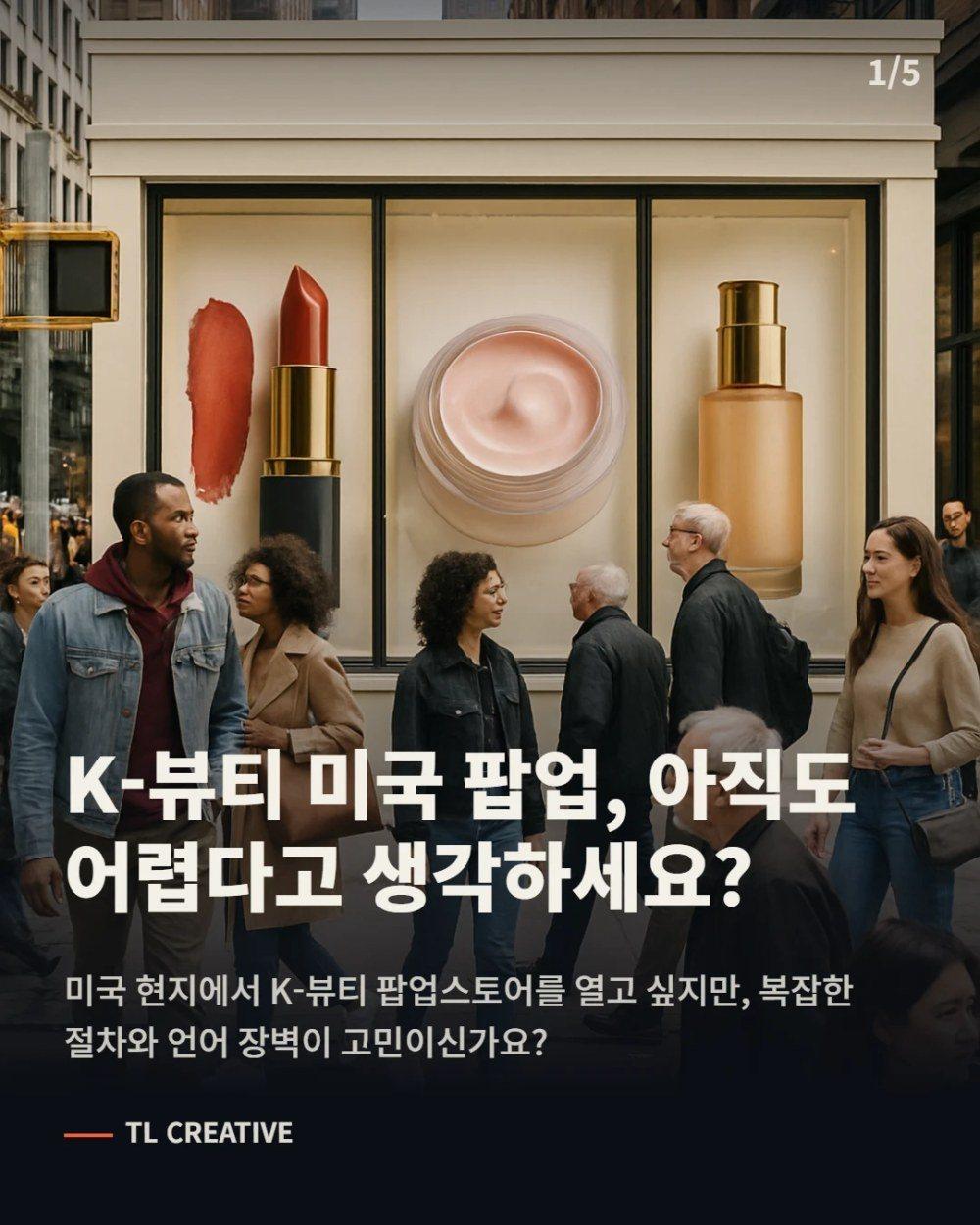
When we get inquiries about popups in the US, the first question is almost always the same: “Can that actually be done over there?” That is still the case even though in July and August 2026 alone, we set up six of them in LA and Pasadena with our local partners.
People expect the procedures to be complicated, they are not confident coordinating on site in English, and above all they feel there will be nothing they can do when a problem breaks out. We understand that worry. But when you actually do it, there are only three points where things get stuck.
The real reason it feels hard
A popup in the US is not hard because the US is special. In most cases it is because the brand has not done many popups to begin with, or has no people on the ground overseas.
Popups in Korea are hard at first, too: how late load-in can run, how many kilowatts of power you get, what the fire codes are. In the US, the time difference and the language are simply stacked on top of that.
The three points where it actually gets stuck
First, how you source the fixtures. If you build them in Korea and ship them, the quality is assured, but sea freight takes 3–5 weeks, and customs adds a few more days. If you are in a hurry there is air freight, but the cost jumps several times over.
Second, when a problem breaks out on site. The drawings do not match reality, a material is missing, the load-in time suddenly changes. In Korea you can just drive over, but in the US you cannot. By the time you have heard the situation over the phone from Korea and made a call, half a day is already gone.
Third, where to keep the fixtures left over when it is over. To reuse them at the next event you have to store them, but you cannot ship them back to Korea every time. And if you throw them away, you have to spend the same money again next time.
So we set up a base on the ground
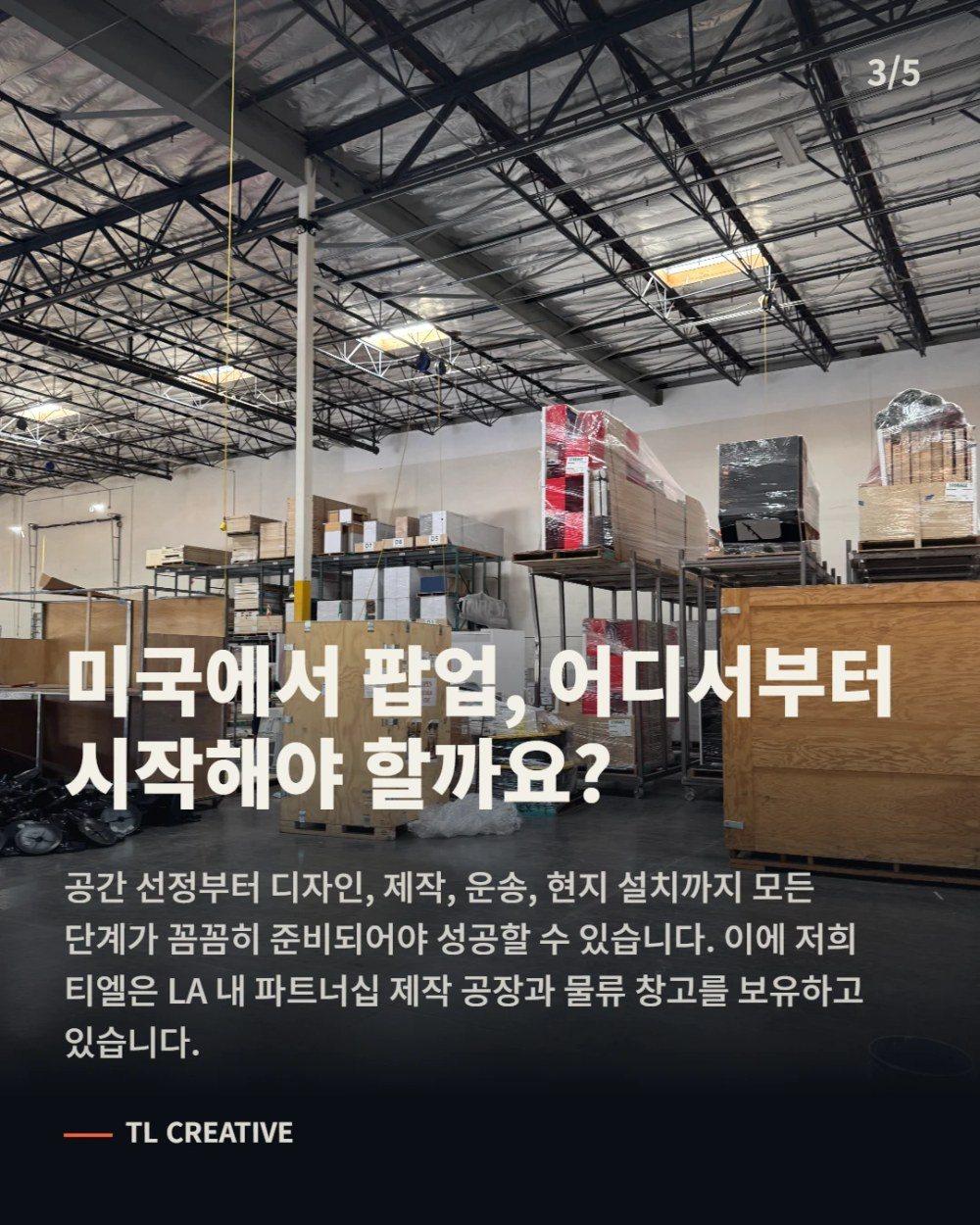
TL CREATIVE has signed an MOU with a local fabrication factory in LA and shares a logistics warehouse inside it.
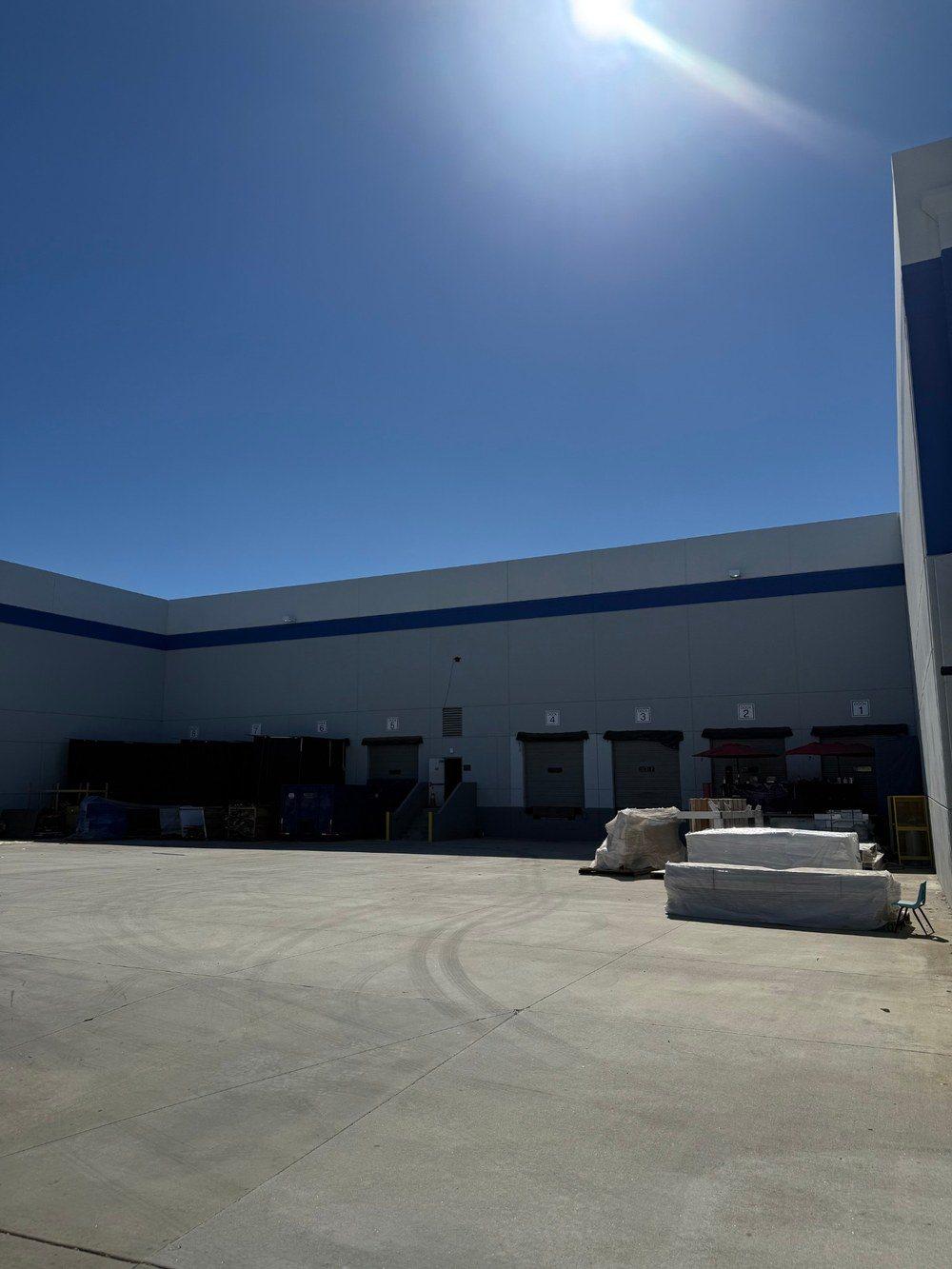
This is not just “we have a local partner” in words. Here is what the place actually is: there is a dock where up to eight trailers can pull in at the same time, with an open yard in front where large vehicles can turn around. Inside is a high-ceilinged warehouse lined with pallet racks, and every slot is numbered, so you can find right away which fixture is where.
In the same building there is a woodworking shop. It is equipped with workbenches and tools, and shipping crates are built there from plywood. Things like counters and chairs are assembled here and go straight out.
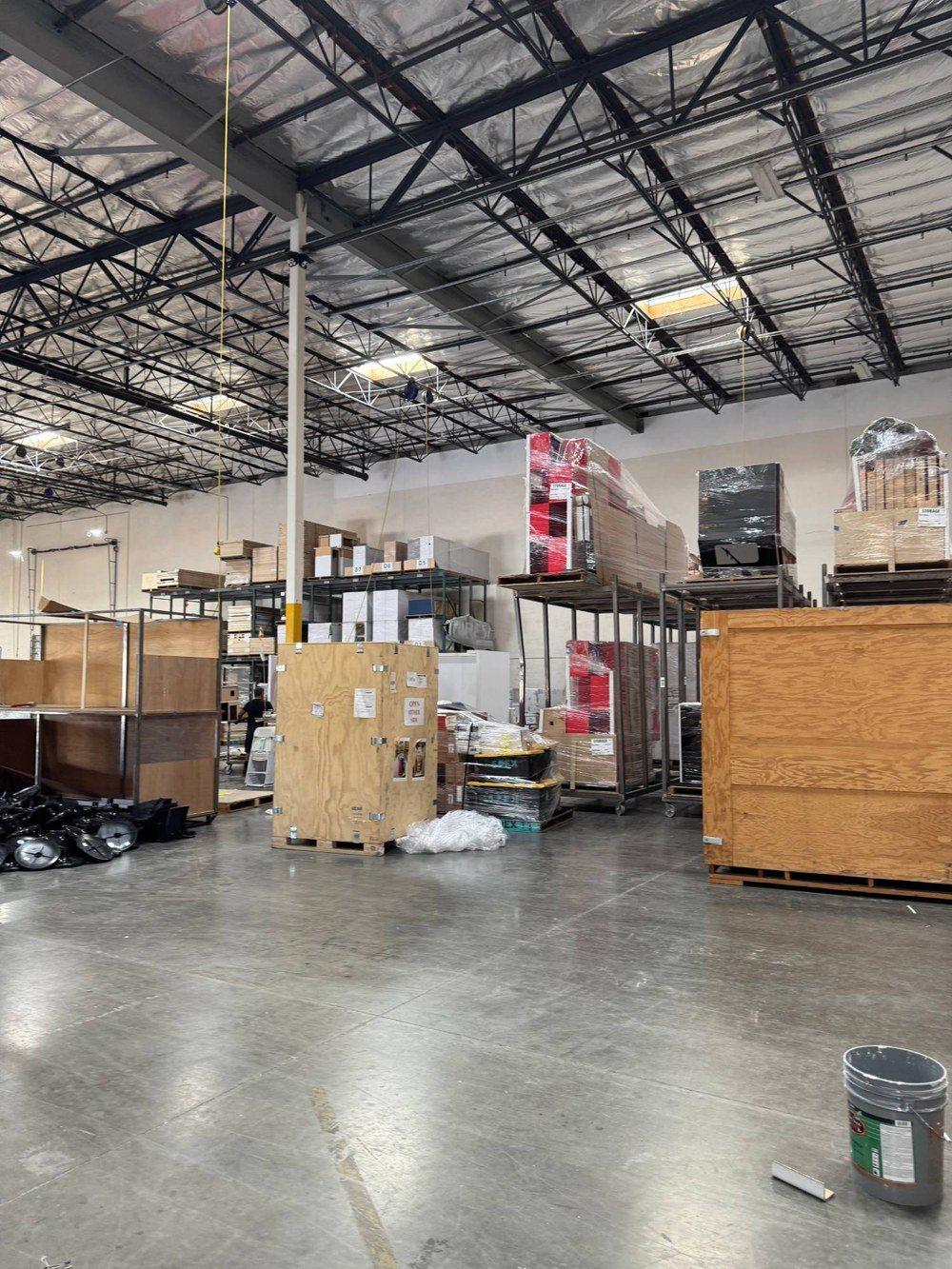
This takes care of all three problems above at once. Since things can be built locally, the shipping lead time disappears, and if something is missing on site, it gets replaced the same day. Fixtures from finished events go up on the racks and are reused at the next event.
Of course, there are cases where shipping from Korea is better. Signage where the finish matters and specially processed parts are better made in Korea. The point is that it is not one or the other; you can choose project by project. Walls and counters locally, brand signage from Korea. Split it this way and you get cost and schedule under control together.
How we actually run it
Planning and design are done in Korea. Decisions are faster when we are in the same time zone as the brand’s team. If you lose a day every time a draft goes back and forth, the schedule falls apart. When brands hand everything over to a local agency, this is where most of them lose time.
Fabrication is split based on volume and finish level. We separate what to make locally and what to send from Korea at the point the drawings are finalized. If you decide this later, it is already too late.
Installation is done on site, together with our local partners. Whether there are people on site the night before opening is what ultimately decides the result. There will always be at least one thing that does not go according to the drawings, and if there is nobody there to make a call on the spot, the store simply opens in that state.
Recent work
In July and August 2026 alone, we carried out five projects in LA and one in Pasadena.
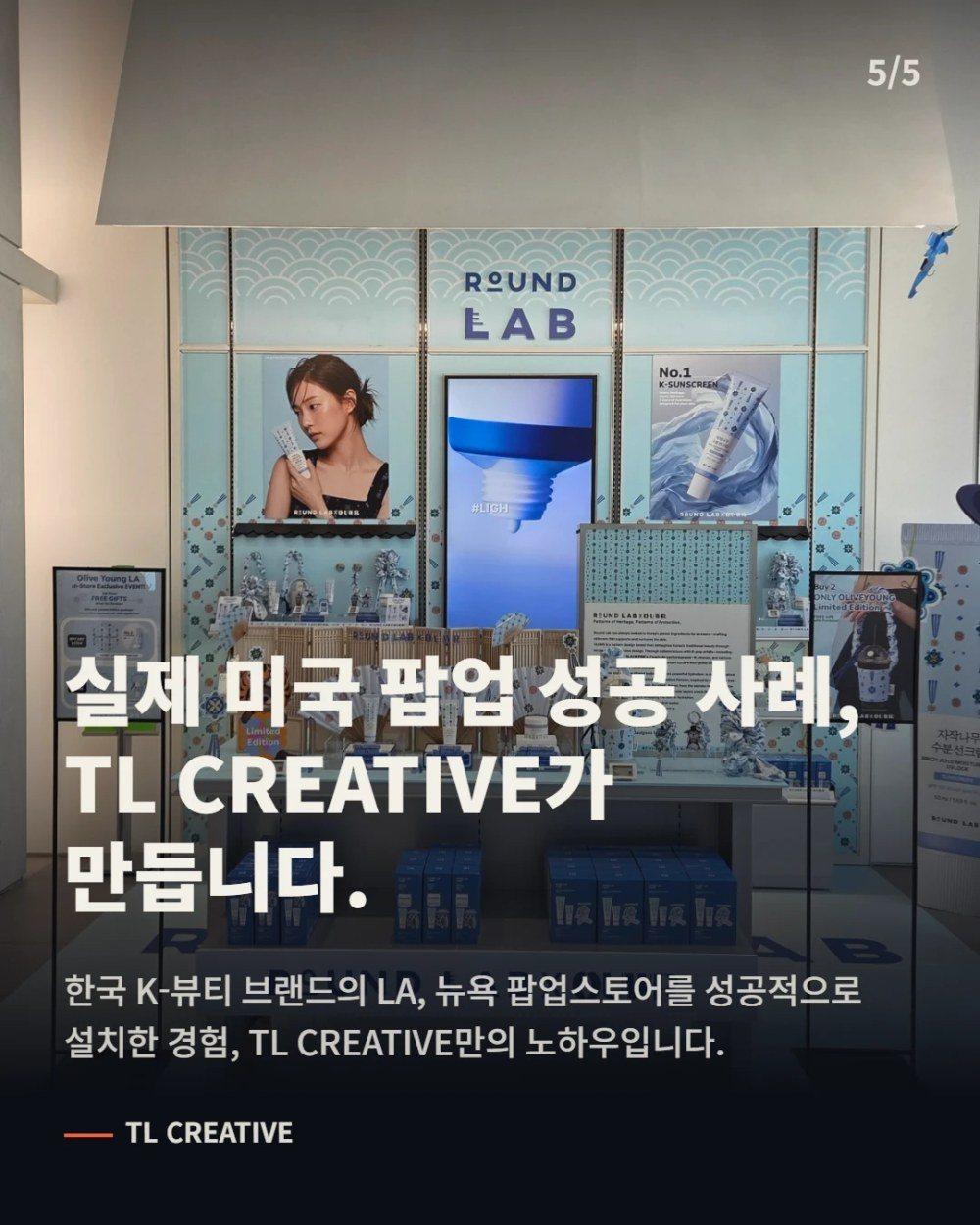
At Olive Young Festa at the LA Convention Center on August 13, we put up booths for three brands, hetras, ROUND LAB, and VT COSMETICS, together on the same day. Each brand had a completely different spatial language, and each had to read differently within the same exhibition hall.
In late July and early August, we installed the ROUND LAB x OUWR limited edition zone at two Olive Young locations, Westfield Century City and Pasadena. It was the same collection, but the store layouts were different, so we solved each one in a completely different way.
In November 2025, we ran the d’Alba LA popup with local partners, from planning through operation.
The US is not what is hard
It is not that popups in the US are hard; they are hard when you have no base on the ground.
If you have a factory and a warehouse you can use right there, most of the lead time and the surprises get sorted out. The rest is not much different from a popup in Korea.
If you are considering a popup in the US or Japan, ask us once before you set a budget. Whether local fabrication or shipping from Korea makes more sense: that decision alone changes the quote.
Project details: https://www.tlcreative.co.kr/projects