
Three Booths on One Show Floor: Olive Young Festa 2026 in Los Angeles
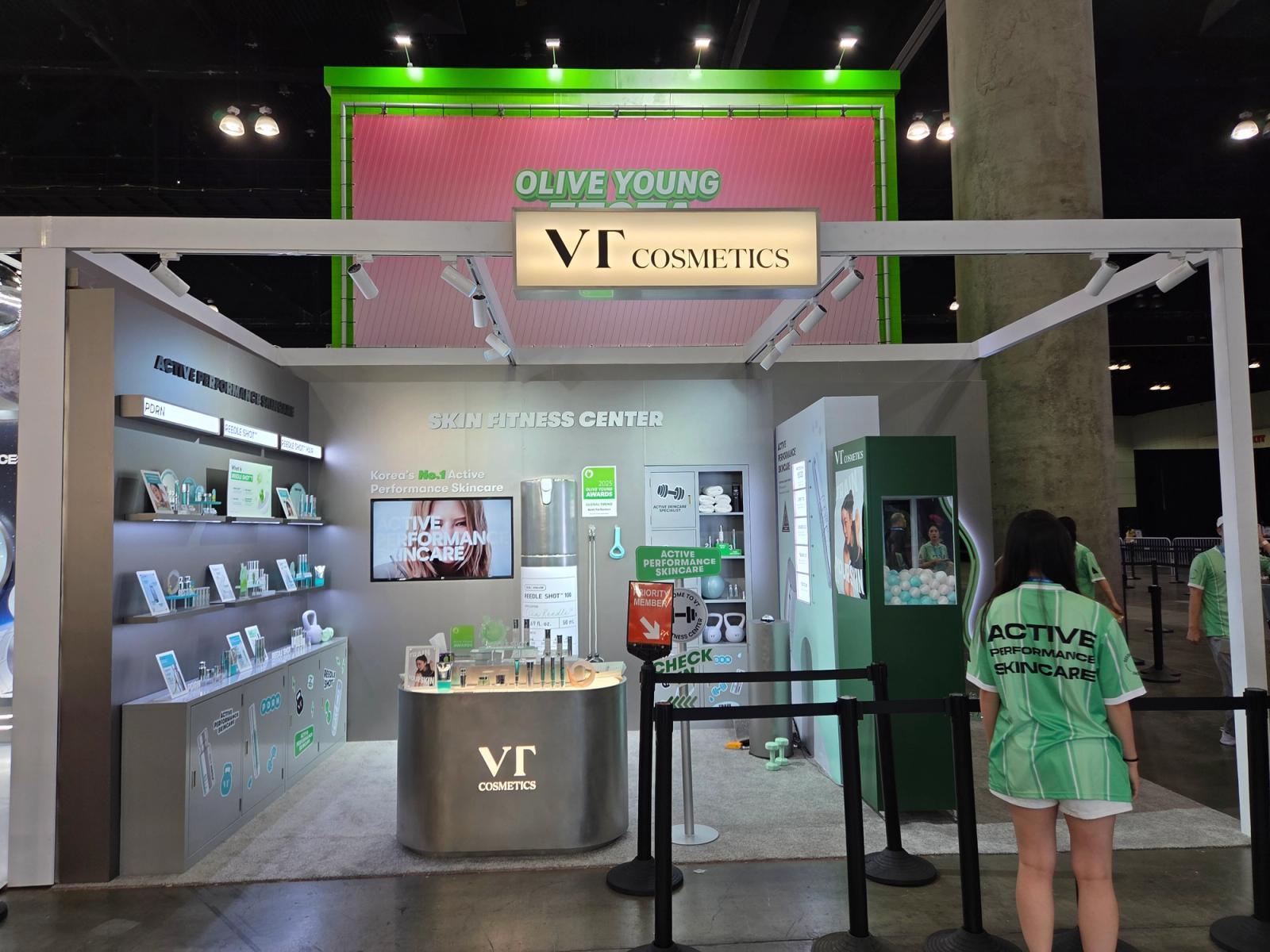
In August 2026 we built three booths at the LA Convention Center for Olive Young Festa. ROUND LAB, VT Cosmetics and hetras, all inside the same show, all going up in the same install window.
The interesting problem was not any one of them. It was that a visitor would walk past all three within a few minutes, and none of them could look like the work of the same team.
ROUND LAB became a bakery
The concept was a bakery. Display cases, a counter, a cookie puzzle on the wall, product presented the way baked goods are presented. For a skincare brand that sounds like a stretch until you stand in front of it, at which point the logic is obvious: a bakery is a room people already know how to behave in. They look, they point, they queue.
On a show floor that matters more than it does on a street. A visitor gives a booth a second and a half before deciding whether to step in. A familiar room buys that second and a half without a word of explanation.
VT Cosmetics became a gym
The Skin Fitness Center was built as a gym. Lockers, a performance wall, product laid out like equipment rather than like cosmetics. Skincare translated into training.
Both booths took a category people think they understand and put it somewhere else. That is the same move twice, and it had to read as two different ideas rather than one house style applied twice. Different materials, different color, different lighting, different heights.
hetras kept the quiet
hetras is a Korean fragrance brand, and fragrance does not survive a loud room. The third booth went the other way: restrained, low contrast, closer to a counter than to a stage. In a hall where every neighbor is competing for attention with saturation and scale, quiet is the thing nobody else is doing.
What three at once actually costs
A convention hall gives you a fixed footprint and an install measured in hours, and it gives the same hours to everyone. Three booths in one window means three crates lists, three install sequences, three sets of venue paperwork, and one crew that cannot be in three places at once.
So the sequencing is decided long before anyone flies. Which booth goes up first is not a question of importance; it is a question of what blocks what. The structure that needs the most drying, curing or rigging time goes first whether or not it is the booth the client cares about most.
Some of it was built in Korea and shipped, some was made in Los Angeles. Where that line falls gets decided again on every project, and on this one it was decided three times, differently, because three booths with different structures do not ship the same way.
What we took from it
Running three brands in one hall is not three times one project. It is one logistics problem with three faces, and the design only survives if the sequence underneath it is right.
The part worth keeping is simpler than that, though. Each of the three had to be legible in under two seconds, from an aisle, to someone who had already walked past forty other booths that day. That constraint did more to shape the designs than any brand guideline did.