
Three Kinds of Space in an LA Pop-Up: Why the Room Decides the Project
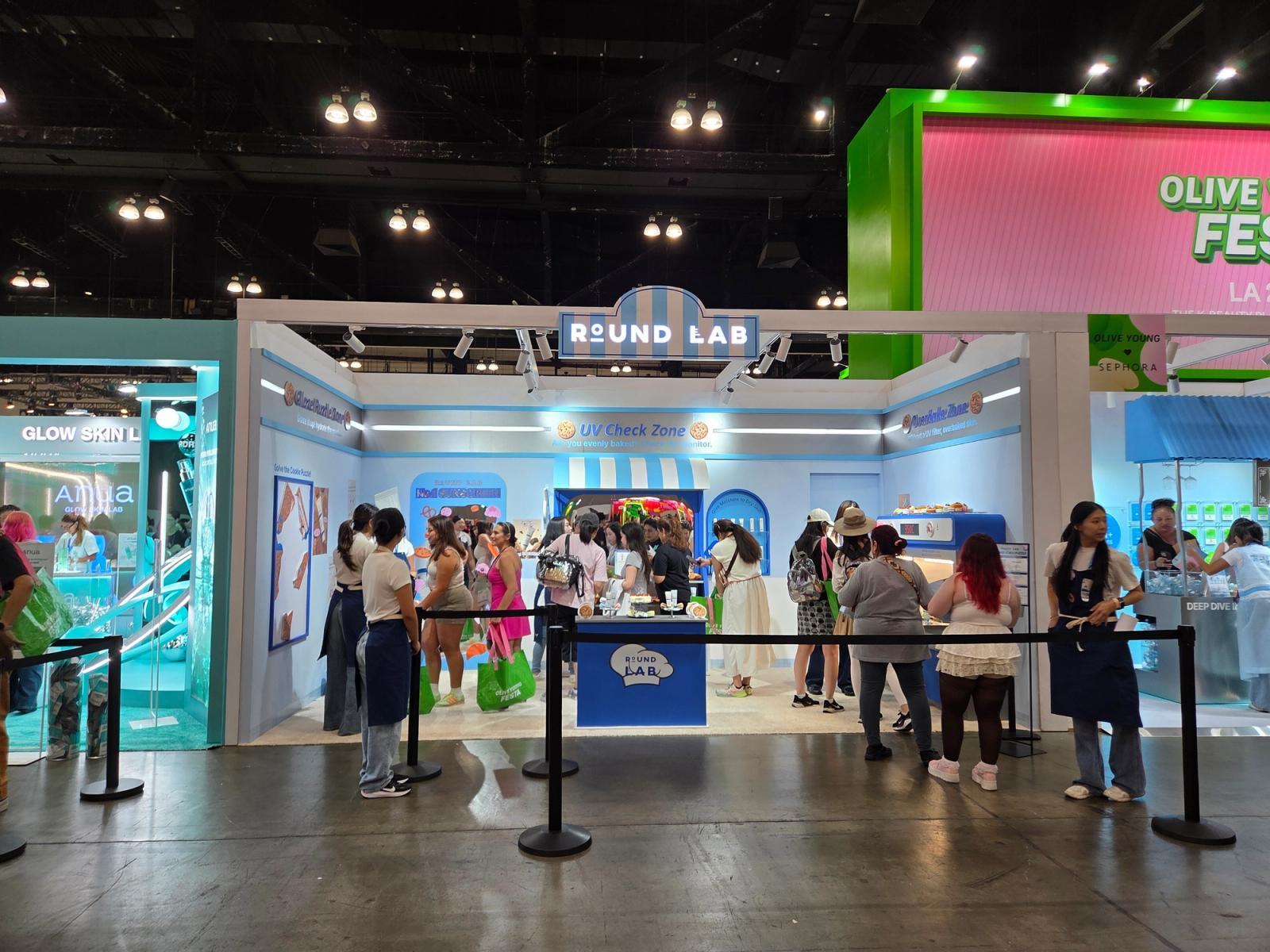
Every few weeks a brand asks us to "do a pop-up in LA." Over the past year that same sentence turned into three projects that had almost nothing in common. All of them were in Los Angeles. All of them were pop-ups. What made them different was the room.
1. A convention floor
At Olive Young Festa 2026 in the LA Convention Center we handled three booths in the same window: VT Cosmetics' Skin Fitness Center, ROUND LAB, and hetras. ROUND LAB's booth became a bakery and VT's became a gym — translating skincare into bread and barbells.
A show floor hands you a fixed footprint and an install window measured in hours. Rigging, flooring, power and labor all follow the venue's rules rather than your judgment. Drawings have to be closed early, because anything shipped has to survive the freight and arrive ready to stand up.
The part brands underestimate is how much of the design is decided by logistics rather than by taste. A shape that cannot be crated, or a finish that will not survive a month at sea, is not a design option no matter how good it looks in the rendering.
2. A retailer's floor
We built the ROUND LAB x OUWR limited-edition zones inside Olive Young Pasadena and Olive Young Westfield Century City. This starts from the opposite place: there is no empty room to design. The shelving is already there, it is not ours, and the fixtures have to be cut to a system somebody else specified.
There is an approval process, and there is an operating store. The install has to finish without the sales floor closing and without getting in the way of customers. How we come in, work and leave is as much a part of the plan as the finished display. Our job has to end. The store's day has to continue.
3. An existing space
d'Alba's White Truffle pop-up on Melrose Avenue was not a case of building every fixture new. We worked with what was already in the space, giving it d'Alba's color and mood while keeping it in tune with the colors the room already had.
That is not the easier option. It means separating what stays from what changes and touching only what needs touching. The brand has to come through clearly without the room and the brand pulling against each other. Starting from an empty shell is in some ways simpler, because nothing is arguing with you.
Korea or Los Angeles: the fabrication split
None of these were made entirely in Korea and shipped, and none were handed wholesale to a local shop. Each was a hybrid: parts built in Korea and sent over, combined with elements fabricated in Los Angeles.
Where that line falls is decided again on every project. Freight volume and cost, lead time, customs, the venue's own material and safety rules, whether anything will be reused afterward, and how much on-site adjustment the schedule can absorb all move it. Shipping schedules and local production schedules run separately, and on install day they still have to land as one space — so finishing each half on time matters, and so does making them meet.
What to decide first
If you are scoping an overseas pop-up, "it is in LA" is not yet enough information to build a budget or a schedule on. A convention floor, an operating store, and an existing space to convert each change what you have to check, how much you actually build, and the order you install in.
So the first question is not what it should look like. It is which kind of room you are walking into, and what you are allowed to do inside it.
TL Creative plans, designs, fabricates and installs pop-up stores in Korea, and works with local partners to do the same in the United States and Japan.